
Embroidery, appliqué… How to personalize your clothes?
If you want to add a personal touch to your hand-sewn garments, you can easily add small elements that will make them unique.
Here are a few techniques to help you stand out from the crowd with a wardrobe that reflects your personality!
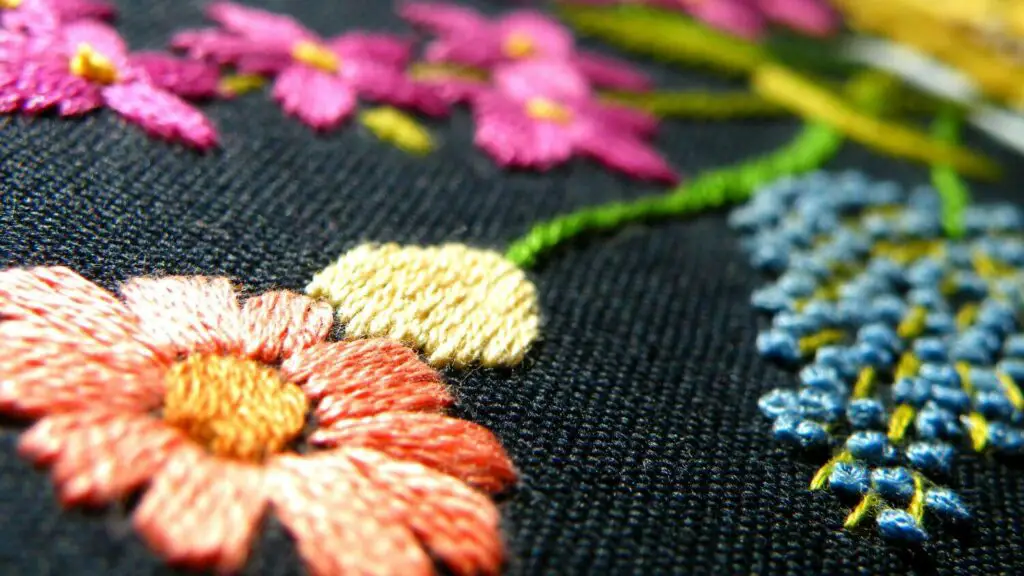
Add embroidery
Embroidery is one of the easiest ways to customize your wardrobe. You can also use this technique to give a second life to weary clothes lying around in your closet, to hide a stain that didn’t wash out, or to patch a small hole.
With just a few simple stitches (stem stitch, festoon stitch, Boulogne stitch, chain stitch, front stitch and back stitch) you can create some very pretty designs.
The DMC website offers an exhaustive list of stitches, with clear diagrams and explanations. A great way to get started in the art of ornament.
You’ll also find plenty of free patterns to give you ideas for embellishing your plain garments.
If you’re new to embroidery, it’s best to customize garments sewn with warp and weft fabric (cotton, linen, denim…). As jersey is stretchy, it’s more difficult to embroider, and the result will be much less clean.
In terms of materials, you’ll need cotton batting, which holds up very well in the wash. Other threads, such as embroidery wool or silk thread, will be damaged in the washing machine.
It’s also a good idea to have a small drum to stabilize the fabric as you embroider. You can also buy self-adhesive water-soluble paper. It’s great for drawing your design, and disappears in the wash once you’ve finished embroidering.
And to avoid being bothered by itchy, irritating threads on the skin, plan to glue a piece of fusible web to the back of your work.
For a discreet effect, you can embroider small areas of a garment: the rounded edge of a collar, the top of a trouser pocket, the elbows of a top, the sleeves of a blouse… And choose the motif you like: flowers, hearts, abstract shapes…
The appliqué technique
Appliqué is a technique derived from patchwork. It involves cutting a shape from a fabric and sewing it onto another surface. The idea if you opt for appliqué is to play with colors and prints: if you have a plain garment, you can add a printed fabric and vice versa.
Or simply use contrasting colors for a color block effect. Or play with textures: combine cotton voile and denim, cotton poplin and sherpa fabric…
As with embroidery, appliqué can be used to personalize a garment. Or to hide a trace or a small hole.
To sew an appliqué, you won’t need any special equipment. All you need is your sewing machine, a small piece of fabric and a matching thread. Simply cut a shape using serrated scissors if you like, position it on the garment and stitch close to the edge.
If you prefer, you can use fabric glue to secure the appliqué before sewing.
This Mondial Tissus video explains each step.
The technique is ideal for adding elbow reinforcement to children’s clothing. Or to decorate blouses, skirts or dresses.

Add bias or lace
To give your garments an original touch, you can also add small, discreet haberdashery elements. Bias, gold or iridescent piping, gold or sequined braid, a piece of lace… Fabric stores are full of these little finishing touches that can make all the difference!
If you’d like to add a bias or fancy ribbon, it’s best to place it on a few small areas of the garment, stitching along each edge of the ribbon.
On pants, stitch the ribbon at the top of the pockets. On a jacket, customize the flap or piping of a pocket by choosing a contrasting color or bright hue.
To add shine to a garment, pearls can also be added to a jacket in a random fashion.
Do you have any favorite techniques for customizing your clothes?