
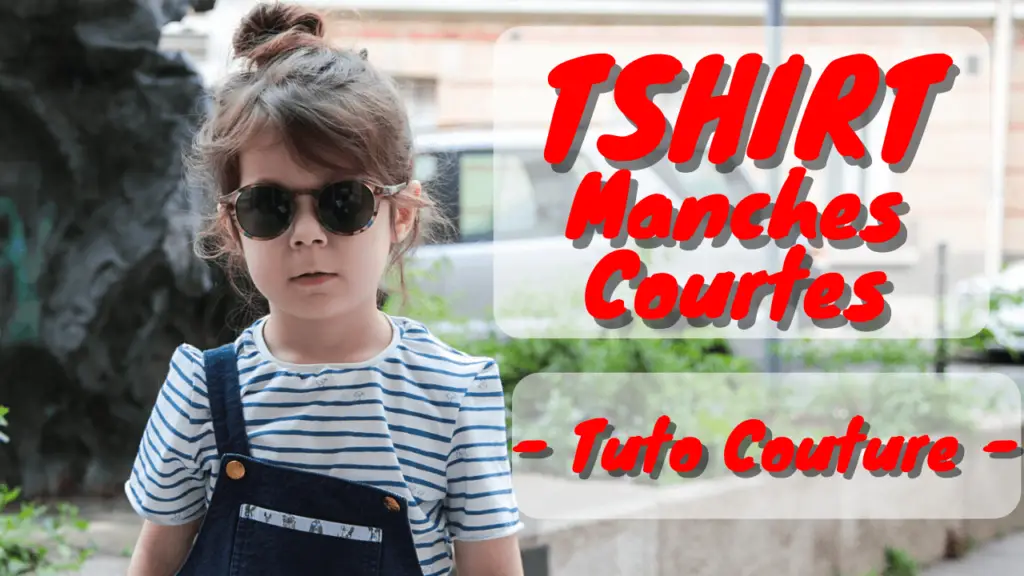
The short-sleeved T-shirt for kids
It’s a wardrobe staple for kids, whether boys or girls! And with summer arriving earlier and earlier, the short-sleeved T-shirt is a must-have!
A T-shirt is always made from jersey fabric! Preferably cotton, ideally organic. And to sew jersey fabric properly, you use a serger.
Don’t have a serger? That’s okay! Of course, you can sew a T-shirt with a sewing machine!
By the way, this T-shirt pattern is available in two versions:
- The free version in size 2, available for download by entering your email address below
You can also join the CoutureEnfant Facebook group (and find all the free patterns in the “Files” tab).
- The PDF pattern is also available in 9 sizes (ages 2 to 9) and can be purchased from my little online store.
Why sew a short-sleeved T-shirt for your child?
The short-sleeved T-shirt is THE item that kids wear almost every day as soon as the weather warms up. Whether worn under overalls, over shorts, as makeshift pajamas for a nap, or as playwear at the park, it’s a staple for every moment of their daily lives.
Sewing it yourself gives you the chance to choose a high-quality jersey fabric that’s gentle on the skin and to customize each piece to suit your little one’s tastes, favorite colors, and even their current mood.
Budget-wise, it’s also a great deal. With just one meter of fabric, you can often sew two T-shirts in sizes 2 or 3 years. And since kids grow so fast, you can update their wardrobe without feeling guilty.
If you like the idea of combining sewing with saving money, take a look at our selection of 5 spring outfits you can sew with less than 1 meter of fabric—you’ll find plenty of additional ideas there.
Sewing supplies:
- A 50 x 110 piece of jersey fabric for a size 2. You can find some nice ones here.
- A special needle for jerseyfabric.
- If needed, a double-pointed needle for hemming.
- And the sewing supplies you’ll need anyway: a pair of paper scissors, fabric scissors, and embroidery scissors; a fabric marker, a FriXion pen, or tailor’s chalk; and glass-headed pins and/or small sewing clips.
Choosing the Right Fabric for a Kids’ T-Shirt
Not all T-shirts are created equal, and the choice of fabric really makes a difference in the final look. For a comfortable and durable short-sleeved T-shirt, here’s what to look for:
- Fabric: Choose a cotton jersey (at least 95%) with a small amount of spandex (5%). It’s the perfect combination: soft, breathable, and the fabric regains its shape after washing.
- Fabric weight: Aim for between 180 and 220 g/m². Anything lighter than that, and the fabric is often too thin and shows the seams. Anything heavier than that, and you’ll end up with thick jersey that’s better suited for sweatshirts.
- The source: Oeko-Tex- or GOTS-certified jersey fabric guarantees a material free of substances harmful to children’s sensitive skin.
- Patterns: For your first sewing project, choose a solid-colored jersey or one with an all-over print (that doesn’t have a specific design)—this will save you from having to worry about matching the pattern on the pieces.
A quick tip: Be sure to wash and dry your jersey fabric BEFORE cutting out the pattern. Cotton shrinks 3 to 5% after the first wash, so it’s better to do this now rather than have the T-shirt become too short after just two weeks!
Sewing Jersey Fabric on a Sewing Machine: Tips That Make All the Difference
An overlocker is great, but it’s not essential. Here are my tips for making a successful T-shirt with just a regular sewing machine:
1. The positive aspect
Forget about the straight stitch that snaps as soon as the child raises their arms! Instead, use:
- The narrow zigzag stitch (width 1, length 2.5): a safe bet.
- The overlock stitch, if your machine has one: it mimics a serger.
- Stretch stitch (often symbolized by a lightning bolt): perfect for seams under tension.
2. Perfect Hemlines
That’s often where things get tricky. The double-jersey needle is your best friend: it creates two parallel lines on the right side and an elastic zigzag on the wrong side, just like a store-bought T-shirt. Be sure to use two spools of thread and slightly reduce the upper thread tension.
3. Stabilize delicate seams
Before sewing, place an iron-on tape or a piece of nylon bias tape on the shoulders—which should not stretch. This will help the T-shirt retain its shape wash after wash.
4. If the fabric puckers or the machine “skips”
Make sure you’re using a jersey needle (with a rounded tip) and not a universal needle. It really makes all the difference. Also, reduce the presser foot pressure if your machine allows it.
The video tutorial
Customize a Short-Sleeve T-Shirt: 5 Design Ideas
Once you’ve mastered the basic pattern, have fun experimenting with it! The short-sleeved T-shirt is the perfect blank canvas to let your creativity shine:
- The color-block effect: combine two different-colored jersey fabrics to create a trendy graphic T-shirt. We explain everything in our article on how to sew and embrace the color-block trend.
- Appliqués: a little heart, a star, or even an embroidered name can turn a basic T-shirt into a one-of-a-kind piece. You can also check out the letter appliqués in the store to decorate your sewing projects.
- The chest pocket: Add a small contrasting pocket on the left—it’s quick and makes all the difference.
- The long T-shirt as a mini-dress: extend the pattern by 15 to 20 cm, and voilà—you’ve got a cute tunic dress for little girls.
- The Family Edition: For matching parent-child outfits, the CRANBERRY pattern —a T-shirt for the whole family— is just perfect.
What should you wear with a short-sleeved T-shirt?
A T-shirt on its own is great. Paired with shorts, a skirt, or a pair of hand-sewn overalls, it’s even better! Here are a few ideas for putting together a complete summer wardrobe for your child:
- Handmade shorts made from printed poplin for a casual look.
- A girl’s skirt made of double gauze, perfect for sunny days.
- Lightweight linen overalls for summer: pair them with a short-sleeved T-shirt tucked in underneath—it’s a winning combination.
If you’re looking for even more inspiration to sew a summer wardrobe, check out our article on summer outfits to sew for kids. And to explore other T-shirt patterns suitable for all seasons, the complete collection of children’s T-shirt patterns is full of gems.
Difficulty Level and Sewing Time
Good news: this short-sleeved T-shirt is a great project for beginners, as long as you’re somewhat comfortable sewing jersey fabric. If this is your very first time working with stretch fabric, I recommend making a test piece with a scrap of fabric before you start on the actual garment.
Allow about 1 hour and 30 minutes to 2 hours to sew your first size 2 T-shirt, from tracing the pattern to the final hem. Once you get the hang of the pattern, you’ll easily be able to finish in 45 minutes! This makes it the perfect sewing project for a rainy Sunday afternoon, or to kick off a sewing session with a quick and rewarding project.
If you’re looking for other simple projects, the collection of patterns for beginners offers a great selection of suitable designs.
FAQ: Everything You Want to Know About Sewing Children’s Short-Sleeve T-Shirts
Can you sew this T-shirt without a serger?
Yes, absolutely! A standard sewing machine will do. Use a narrow zigzag stitch or an overlock stitch if your machine has one. The result will be just as sturdy and attractive.
How much jersey fabric should I plan for?
For the 2-year-old size, 50 x 110 cm is sufficient. For larger sizes (up to age 9), allow about 70 to 90 cm of jersey fabric with a width of 140–150 cm. Always allow a little extra for pre-washing and any necessary pattern adjustments.
My jersey keeps rolling up at the edges—is that normal?
Yes, that’s just how jersey fabric is! To minimize this, cut your pieces right before sewing them (not the day before), and work on a flat surface. You can also pin the edges immediately after cutting.
What size should I choose for my child?
Always go by the measurements (chest circumference and height) rather than the age range listed. Children come in all shapes and sizes. If you’re unsure between two sizes, choose the larger size—the jersey fabric is so comfortable that the T-shirt will last longer.
Can this T-shirt be turned into a long-sleeved version?
Of course! By the way, the pattern you’re receiving has long sleeves, and there’s an additional (free) PDF file included with the short-sleeve version.
The T-shirt is too tight around the neckline. What should I do?
It’s common for the neckband to be cut too long. It should be shorter than the neck circumference (about 80 to 85% of that measurement); that’s what creates the nice, snug fit.
Get to your machines!
You now have everything you need to make a great short-sleeved T-shirt: a free pattern to try out, the right tools, tips for working with jersey fabric, ideas for variations, and even inspiration for putting together a complete outfit.
All you have to do is pick out a pretty piece of fabric, thread your thimble, and get started!
And don’t forget: the first T-shirts are never perfect, but kids always wear them with pride. That’s the magic of handmade items!